
Five Elements and Eight Trigrams
The Five Elements and Eight Trigrams consist of the theories of Yin-Yang and Five Elements as well as the Eight Trigrams. They are basic philosophical concepts of the ancient Han nationality and belong to the ancient Yin-Yang doctrine. Specifically, the “Five Elements” refer to the Metal element, Wood element, Water element, Fire element, and Earth element. They have always been tools and methods used by ancient Han sages in various researches. Whether it is Taoism, medicine, military strategy, Confucianism, historiography, eclecticism, or calendar calculation, one must be proficient in the “Five Elements”.
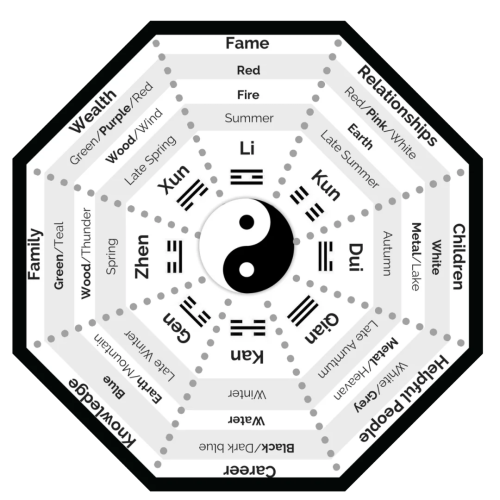
The Eight Trigrams are a continuation of Yin-Yang and the Five Elements, and they also divide all things into eight categories. The Eight Trigrams are: Qian, Kan, Gen, Zhen, Xun, Li, Kun, and Dui. They are usually applied in disciplines such as orientation, divination, and feng shui. And the discipline that can bring the Eight Trigrams into full play is *Meihua Yishu* (Plum Blossom Yi Number).
The *I Ching* (Book of Changes) is the theoretical origin of natural philosophy and humanistic practice in the traditional ideological culture of the Han nationality. It is the crystallization of the thoughts and wisdom of the ancient Han nationality, known as “the source of the great way”. It was the learning of ancient emperors and a compulsory skill for politicians, military strategists, and merchants. The *I Ching* covers everything and governs all things, standing as an outstanding representative of the traditional culture of the Han nationality; it is extensive and profound, encompassing all aspects of things. According to *Records of the Grand Historian·Annals of the Zhou Dynasty*, it is recorded that: “When King Wen was imprisoned in Youli, he probably expanded the Eight Trigrams of the *I Ching* into sixty-four trigrams.” That is to say, at that time, King Wen (Xibo Chang) was framed by Chonghou Hu and imprisoned in Youli by King Zhou of the Yin Dynasty for a full seven years. During his imprisonment, Xibo Chang devoted himself to studying the *I Ching* and the Eight Trigrams, and deduced the sixty-four trigrams recorded in the *I Ching* such as Qian as Heaven, Kun as Earth, Shui Lei Tun (Water and Thunder·Sprouting), Shan Shui Meng (Mountain and Water·Ignorance) through the overlapping of the Eight Trigrams.
Summary
The Eight Trigrams (Bagua) are a set of symbolic signs from ancient China. The unbroken line “—” represents Yang, and the broken line “— —” represents Yin. Eight forms are composed of three such lines, which are called the Eight Trigrams.
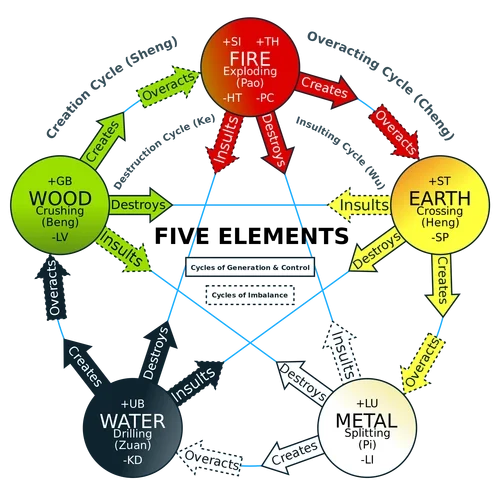
The so-called Five Elements refer to Metal, Wood, Water, Fire, and Earth. The first thing to note when studying them is that if a fortune-teller takes “Xing” (the Chinese character for “Element” here) as “walking”, that would be completely wrong. When we read *I Ching*, there is a sentence in the Qian Gua: “Heaven’s movement is vigorous”. Here, “Xing” (movement) represents motion, that is, “kinetic energy”. The greatest interrelationship between substances in the universe lies in this kinetic energy. This “kinetic energy” has five types, represented by Metal, Wood, Water, Fire, and Earth. Like the trigrams, they are traditional symbols and should not be taken too literally. The so-called “Metal” does not refer to gold, nor is “Water” the same as the water we drink from a cup. It is crucial not to think that the Five Elements are just five kinds of substances.
The Applications of the Five Elements and Eight Trigrams
The Five Elements correspond to the organs in the human body: the liver belongs to Wood, the heart to Fire, the spleen to Earth, the lungs to Metal, and the kidneys to Water. This correspondence helps infer the interrelationships between the five Zang-organs, explaining physiological phenomena and pathological changes in the human body. The Eight Trigrams can also correspond to human body parts and meridians, aiding TCM diagnosis and treatment. For example, a blue-green complexion may indicate liver qi stagnation, and a red tip of the tongue often suggests excessive heart fire. In tongue diagnosis, the tip of the tongue corresponds to the Li Gua (Fire, representing the heart), and the root of the tongue corresponds to the Kan Gua (Water, representing the kidneys). In treatment, the principle of generation and restriction among the Five Elements is applied; for instance, insufficient liver blood can be indirectly nourished by tonifying kidney Water.
In feng shui, the influence of living spaces or cemeteries on residents or descendants is judged by analyzing factors such as orientation and terrain, combined with the attributes of the Five Elements and the directions of the Eight Trigrams. For example, the east belongs to Wood, making it suitable for planting trees to enhance vitality; the Qian position (northwest direction) is ideal for a living room or study. The principle of mutual generation and restriction of the Five Elements is also used to adjust the placement of items in a room to harmonize energy flow. For example, adding wooden decorations in the kitchen can promote the energy cycle of “Water generating Wood”.
In Bazi (Four Pillars of Destiny) numerology, a person’s Five Elements attributes and Eight Trigrams patterns are determined by analyzing the heavenly stems and earthly branches corresponding to their birth year, month, day, and hour. This is used to infer personality traits, career fortune, and marital status. The relationships of generation and restriction among the Five Elements help judge the interactions between various elements in the destiny chart and their impact on an individual’s life.
Using the principles of the Five Elements and Eight Trigrams to name children or enterprises is a common practice. The number of strokes and structural forms of characters in names can correspond to the Five Elements and Eight Trigrams. Appropriate characters are chosen to supplement or balance the energy field of individuals or enterprises. For example, for a person lacking Water in their Five Elements, characters with the “water” radical (such as 氵,水) can be used in their name.
The Eight Trigrams are an important tool in I Ching divination. By analyzing the combinations and changes of the trigrams, combined with the principles of generation and restriction among the Five Elements, predictions can be made about the development trends, good or bad fortune of things. For example, the 64 hexagrams in I Ching are formed by combining two trigrams, each with specific meanings and symbols, which can be used to interpret various situations.
The color theory of the Five Elements and the imagery of the Eight Trigrams are often used in painting, calligraphy, and other art forms to express emotions and artistic conceptions. For example, red, belonging to Fire, represents passion and vitality. The five-tone scale (Gong, Shang, Jiao, Zheng, Yu) corresponds to the Five Elements, creating different musical atmospheres through combinations of different notes. Additionally, the symbols and concepts of the Eight Trigrams provide rich inspiration and expressive techniques for painting; artists often use the Yin-Yang changes in the trigrams to reflect the virtual-real and dynamic-static relationships in their works.
Ancient people associated the four seasons with the Five Elements: spring with Wood, summer with Fire, autumn with Metal, and winter with Water. Agricultural activities are arranged according to the Five Elements attributes of different seasons—spring is suitable for sowing and tree planting, while autumn is ideal for harvesting and storage. The Eight Trigrams are also closely related to the 24 solar terms, with each trigram corresponding to specific solar terms and time periods, guiding field management.
Some enterprise managers correspond various departments or links of the enterprise to the Five Elements. For example, the production department belongs to Wood, the sales department to Fire, and the financial department to Metal. By analyzing the Five Elements relationships between departments, they coordinate inter-departmental cooperation and development. Furthermore, the systematic view and Yin-Yang balance concept of the Eight Trigram diagram are used to harmonize departmental relationships, emphasizing the balance between incentives and constraints, innovation and stability.