
Prayers through Zhaijiao rituals have existed since ancient times. As early as before the Eastern Han Dynasty, terms such as “fasting (zhaijie)”, “sacrifice (jiao)”, and “altar (tan)” emerged, indicating that Taoist Zhaijiao rituals originated from ancient Chinese prayer ceremonies. During the Eastern Han Dynasty, after Taoism came into being, Emperor Huan of Han personally worshipped Laozi at Zhuolong. A shrine was built as an altar, adorned with pure gold – inlaid utensils and a canopy – covered seat, and the music for worshipping heaven was played (as recorded in Book of the Later Han). It is evident that at this time, Zhaijiao prayers not only had altars and offering utensils but also music – the music for worshipping heaven. In the Eastern Han Dynasty, the Taiping Dao already had rituals like praying to heaven and giving thanks; the Tianshi Dao also had fasting rituals such as “Tucan Zhai” and “Zhijiao Zhai”. Those who prayed would “cover their faces with loess and hang their heads with their hands tied behind their backs”, and the rituals were simple. In addition, the Tianshi Dao had the “Sanguan Shoushu” for praying for patients. The specific method was: “Write the patient’s name and express the intention of confessing sins. Make three copies: one is offered to the mountain and placed on the mountain, one is buried in the ground, and one is sunk in the water.” (as seen in Records of the Three Kingdoms·Biography of Zhang Lu). Although this kind of ritual was very simple, it already had the embryonic form of the memorials in Zhaijiao rituals. According to Book of Wei·Records of Buddhism and Taoism, when Zhang Daoling first founded the religion, because he taught some fasting and sacrificial methods from Tian Gong Zhang Ben, his disciples “each mastered the Daoist methods, and thus, these practices became widely popular”. Tian Gong Zhang Ben can be regarded as the earliest book on rituals and sacrifices. In short, this period was the initial stage of Taoist rituals, so the content and form of the rituals were very simple. However, it is undeniable that Zhaijiao rituals came into existence.

During the Eastern Jin and Southern and Northern Dynasties, through the elaboration of Taoists from the Shangqing School and Lingbao School, Zhaijiao rituals gradually formed a complete set of norms and procedures. In the second year of Xingning during the reign of Emperor Ai of the Eastern Jin Dynasty (364), Yang Xi and Xu Mi, disciples of Lady Wei, founded the “Shangqing Altar” in Maoshan and used the seal of “Jiulao Xiandu Jun”. During the Long’an period of Emperor An of the Eastern Jin Dynasty (397 – 401), Ge Chaofu, the grandson of Ge Hong, wrote more than 30 volumes of Lingbao Sutra. By the Southern Dynasties, Lu Xiujing further revised and supplemented them, making them widely popular. He established the “Lingbao Mysterious Altar” in Gezao Mountain, using the seal of “Yuanshi Zongtan” and the bronze seal of “Yuanshi Wanshen”.
During the Northern Wei Dynasty, Taoist Kou Qianzhi took the lead in reforming the Northern Tianshi Dao, advocated rituals and etiquette, and changed the way of reciting scriptures from “straight recitation” to “recitation with rhythm”. Since then, reciting scriptures in Zhaijiao rituals has included musical elements. Kou Qianzhi wrote Yunzhong Yinsong Xinke Zhi Jie and Lu Tu·Zhen Jing, which further developed and improved the rituals. After Kou Qianzhi, Lu Xiujing, a Taoist of the Lingbao School in the Liu Song Dynasty of the Southern Dynasties, also reformed the Southern Tianshi Dao and sorted out Zhaijiao rituals on the basis of compiling the classics of the Three Grottoes. He once wrote more than 100 volumes of Zhaijiao rituals, including various fasting rituals such as the Lingbao Six Fasts, Nine Fasts, and Twelve Fasts, as well as many Zhaijiao music pieces like Shengxuan Buxu Zhang. After the compilation and revision by Kou Qianzhi and Lu Xiujing, Zhaijiao rituals gradually took shape and became perfect. They basically stagnated in the Sui Dynasty but were still valued.
Zhaijiao rituals prevailed in the Tang, Song, and Yuan dynasties along with the development of Taoism.
Emperor Xuanzong of Tang ordered in the 10th year of Kaiyuan (722) and the 29th year of Kaiyuan (741) that two temples for Emperor Xuanyuan should be built in both capitals and various states, and Zhaijiao rituals should be held every year according to Taoist methods. During this period, he also “personally taught Taoists the rhythm of Buxu in the Taoist temple” and ordered Taoists Sima Chengzhen and Li Hanguang to compose Xuanzhen Dao Qu and Da Luo Tian Qu, etc. When Emperor Wuzong of Tang ascended the throne (841), he summoned 81 Taoists including Zhao Guizhen into the palace to hold the Jinlu Daochang in the Three Halls. The emperor visited the Three Halls and personally received the Taoist ordination at the Nine Heavens Altar. Du Guangting, a Taoist in the late Tang and Five Dynasties, was the synthesizer of Taoist Zhaijiao rituals. He collected, sorted, compiled, and revised various rituals since the Southern and Northern Dynasties. On this basis, he also compiled many ritual books such as Tai Shang Zheng Yi Yue Lu Yi, Dong Shen San Huang Qi Shi Er Jun Zhai Fang Chan Yi, and Dao Men Ke Fan Da Quan Ji, which had a profound influence.
During the reigns of Emperors Taizong, Zhenzong, Shenzong, Zhezong, and Huizong of the Northern Song Dynasty, historical records continuously document imperial court rituals. In the second year of the Dazhong Xiangfu era (1009), Emperor Zhenzong commissioned the Taichang Yili Yuan (Court of Imperial Sacrifices and Rites) to codify the ceremonies for the Tianqing Daochang and disseminated these regulations across all prefectures. Then, in the second year of the Daguan era (1108), Emperor Huizong issued the Jinlu Lingbao Daochang Yi Fan (Ritual Protocols of the Golden Register and Numinous Treasure Daoist Altar) nationwide, mandating that Taoist practitioners adhere to its guidelines.
During the Jin and Yuan dynasties, sacrifices were held in temples in the capital and famous mountains in large cities (such as Longhu Mountain, Gezao Mountain, Maoshan, etc.). Not only Taoists of the Zhengyi School but also Qiu Chuji and Wang Chuyi of the Quanzhen School, Xiao Zhichong and Xiao Jushou of the Taiyi School, etc., successively presided over sacrificial affairs by the order of emperors of the Jin and Yuan dynasties. Thus, Zhaijiao rituals were practiced by various schools.
After the Ming Dynasty, Taoism declined, but Zhaijiao rituals still spread among the people. During this period, many folk religions emerged and spread widely, and many Zhaijiao rituals were absorbed by them. At the same time, many large – scale Zhaijiao rituals were lost because they could not be undertaken, while small – scale ones were further simplified to better meet the needs of ordinary people, so they have been handed down to this day.
Lou Jinyuan, the supervisor of Shangqing Palace in Longhu Mountain during the Qing Dynasty, compiled 12 volumes of Zhaijiao rituals into Huanglu Keyi, which became a model for modern rituals.
A Zhaijiao ritual is typically completed through a sequence of ceremonies, including building an altar, arranging ritual supplies, reciting scriptures and performing repentance rites, practicing “bugang tado” (stepping in patterns mimicking the Big Dipper constellation), making mudras (finger gestures), and chanting mantras.

Building the Jiao Altar
To hold a Jiao ritual, an altar must first be constructed, referred to as “Jiaotan” (醮坛) or “Fatan” (法坛). The term “tan” (坛) denotes a raised platform built with earth on flat ground, used for worshipping celestial deities and ancestors. Ancient Jiao altars were originally open – air structures, later moved indoors into halls. Different forms of Zhaijiao rituals feature altars of varying scales. Large – scale Zhaijiao events usually include several altars: one main altar called “Dutan” (都坛), and the others known as “Fentan” (分坛,subsidiary altars).
Inviting Deacons
In Zhaijiao rituals, Taoists with specific titles and responsibilities are collectively termed deacons, or Jiaotan deacons. According to Jinlu Dazhai Buzhi Shuocheng Yi (Rituals for Supplementing Positions in the Grand Golden Register Fasting), the key deacons are as follows:
- Gaogong (高功): Ranks first among all deacons. Those holding this position must be “endowed with inner virtue and outer dignity, revered by both humans and celestial beings, and respected by spirits”. During the ritual, they “follow divine guidance, convey celestial will, bless the three realms (heaven, earth, and the underworld), and uphold rituals above all other officials”.
- Jianzhai (监斋): Second only to Gaogong. Its duties include: first, “overseeing ritual codes, managing regulations and prohibitions, correcting altar duties, and maintaining ritual order”; second, “scrupulously checking for errors, calmly issuing decrees, acting with strictness and assistance, and avoiding excess or negligence”. It serves as Gaogong’s deputy, overseeing ritual laws and norms.
- Dujiang (都讲): Together with Gaogong and Jianzhai, they form the “San Fashi” (三法师,Three Masters). Those in this role must be “versatile in knowledge, skilled in rituals, proficient in chanting and guiding ceremonies, and capable of leading the assembly”; they “move in the sacred altar, ascend the seat to lecture, meet public expectations, and resonate with the hearts of believers”. As another deputy to Gaogong, Dujiang is in charge of chanting and guiding the ritual process.
The Zhengyi School refers to these three roles as “San Fashi”, while the Quanzhen School only uses the title “Gaogong” without the term “Fashi”. Nevertheless, all three have distinct functions in Zhaijiao rituals, complementing one another to lead the ceremony. Other deacons include Shijing (侍经,Scripture Attendant), Shixiang (侍香,Incense Attendant), Shideng (侍灯,Lamp Attendant), Zhiqing (知磬,磬 Chime Master), and Zhizhong (知钟,Bell Master), each with specific duties.
Ritual Discipline on the Jiaotan
Taoist Jiaotan adheres to strict protocols called “Weiyi” (威仪,dignity). Since Taoism regards Zhaijiao as a sacred communion between humans and deities that must not be treated lightly, clear rules are established to “warn against laziness and disrespect, check for transgressions, observe conduct, and assess sincerity. Any faults are to be corrected promptly”. Tianhuang Zhidao Taiqing Yuce (The Supreme Purity Jade Manual of the Heavenly Emperor’s Ultimate Dao) contains Jiaotan Qinggui (醮坛清规,The Clear Rules of the Jiao Altar) with 35 articles, reflecting the strict discipline of the altar.
Ritual Implements and Supplies
The Jiaotan is equipped with essential items. In addition to incense burners, lamps, flowers, ritual tools, and “chuangfan” (幢幡,pennants and streamers), the key items include: Fu Jian (符简,talismanic slips), Zhang Biao (章表,memorials to deities), and Fa Shui (法水,consecrated water).
Operational Forms of the Ritual
Jiaotan rituals feature unique practices, including external methods such as mantra – reciting with mudras, “bugang tado”, incense chants, and ritual protocols, as well as internal cultivation techniques like visualization, “yunhui” (運讳,channeling divine inscriptions), teeth – tapping, and gathering spirits.
Mantras
A “zhou” (咒,mantra) refers to incantations that connect with divine beings. In ancient times, “zhou” was interchangeable with “zhu” (祝,invocation) and typically ends with “jiji rulvling” (急急如律令,”hastily as per celestial edict”). Chanting mantras serves to summon deities, expel evil spirits, protect life, and shield the body.

Mudras
A “jue” (诀,mudra) is a specific hand gesture formed by interlocking or pinching fingers, with the action known as “qiajue” (掐诀,forming the mudra). Mudras enable communion with the true divine, subdue evil forces, command spiritual generals, and facilitate ritual affairs. Different deities correspond to distinct mudras, such as the Lingguan Mudra and Doumu Mudra.
Steps
“Bu” (步,steps) refers to “bugang tado” (踏罡步斗,treading the Big Dipper pattern). Traditionally attributed to Yu the Great of the Xia Dynasty, it is also called “Yubu” (禹步,Yu’s steps). “Gang” (罡) denotes Tiangang (the Big Dipper’s handle), and “dou” (斗) refers to the Big Dipper constellation. On the altar, the Gaogong (high priest) uses a square – sized space to symbolize the nine celestial realms. By stepping in alignment with the positions of stars and the Big Dipper, they spiritually ascend to the nine heavens to present petitions to the celestial court. There are various “gang” step patterns, including the Three Treasures Gang, the Twenty – Eight Lunar Mansions Gang, and the Jiaotai Gang, each with unique purposes.
Lamps
“Lamp” (灯) refers to the ritual of lighting lamps and candles on the Jiaotan (altar). Initially an independent ceremony, it was later integrated into other rituals. Its purpose is to illuminate the celestial court above, penetrate the underworld below, and deliver the souls of the deceased. Hence, after a person’s death, it is essential to “imitate heaven and earth, light lamps and declare talismans” to achieve “liberation from suffering”.
Worship
“Worship” (礼拜) is the most common ritual in Taoist Jiaotan. Commonly known as “kowtowing” or “bowing”, both Taoists and believers must perform worship when facing divine statues inside or outside Taoist temples. This is the primary and fundamental practice for those entering Taoism.
Scripture Recitation
“Scripture recitation” (诵经) is a prevalent ritual in Taoist Jiaotan, involving the chanting of scriptures. Beginners of rituals must first master scripture recitation. It can be done individually or collectively; a scripture may be chanted once or multiple times. There are various methods, including mental recitation, verbal recitation, spiritual recitation, mental invocation, secret invocation, and subtle invocation. The ultimate goal of scripture recitation is to eliminate natural disasters above, protect the emperor; ward off poisons below, and save the people, so that both the living and the dead can rely on its blessings, which are immeasurable.
Buxu
“Buxu” (步虚) refers to the melody used for chanting verses on the Jiaotan. It is said that its rhythm resembles the ethereal steps of immortals walking in the void, hence also known as “Buxu sheng” (步虚声,the sound of Buxu). The lyrics set to Buxu melodies are called “Buxu ci” (步虚词,Buxu verses). Buxu chanting features beautiful melodies and profound artistic connotations. The great poet Du Fu praised it: “This melody should originally exist in heaven; how many times can it be heard in the mortal world?”
Visualization
“Visualization” (存想), also known as “cunsi” (存思) and abbreviated as “cun” (存), requires closing or half – closing the eyes to mentally visualize and observe the appearance and activities of a specific object or divine being. The aim is to concentrate the mind, eliminate distractions, and enter a state of communion between humans and gods. Taoism holds that without mastering visualization in Jiaotan rituals, communication between the human and divine worlds is impossible, and the Zhaijiao would lose its significance. The objects of visualization are extensive, including celestial phenomena (sun, moon, stars, clouds, mist, etc.), scenery (qi, flames), the human body (five internal organs, dantian), and divine beings (internal gods within the body, external gods), etc. Most of these techniques are secretly passed down between masters and disciples.
Teeth – Knocking
“Teeth – knocking” (叩齿) involves tapping the upper teeth against the lower teeth to gather spirits and expel evil. It is generally divided into “mingtiangu” (鸣天鼓,beating the heavenly drum, tapping the left teeth), “jitianqing” (击天磬,striking the heavenly chime, tapping the right teeth), and “mingfagu” (鸣法鼓,beating the ritual drum, tapping the front teeth). Tapping the left teeth is to respond to the divine by striking the gate of heaven; tapping the right teeth is used for subduing and expelling evil; tapping the front teeth to beat the ritual drum is to communicate with the true divine and reach the Supreme Emperor, and is used for presenting memorials to the celestial court (see Tianhuang Zhidao Taiqing Yuce).
Presenting Memorials
“Presenting memorials” (进表) refers to the ritual where Taoists submit “biao wen” (表文,green – word memorials) to the celestial court, also known as “shangbiao” (上表,presenting a memorial). Its procedures include opening the altar, inviting the saints, and worshipping the memorial. Its usage depends on the rank of the deity: presenting to the highest Taoist deity is called “shangdabiao” (上大表,presenting a grand memorial), while presenting to ordinary deities is called “shangshu” (上疏,submitting a document). Finally, the memorial is burned, called “huabiao” (化表,transforming the memorial), in the hope that it will be delivered to the celestial court, inform the heavens, and that all saints will come to the altar, bestowing blessings and prolonging life, and that ancestors will be delivered.
Refining and Delivering
“Refining and delivering” (炼度) involves using talismans and rituals to transform ghosts and gods, enabling their salvation. “Lian” (炼,refining) refers to using true water and true fire to refine the souls of the deceased; “du” (度,delivering) refers to practicing fasting and performing rituals to deliver wandering spirits. Its function is that “living people can recover their vitality by using it (talismanic methods), and ghosts and gods can also be transformed by obtaining it” (see Shangqing Lingbao Dafa·Shuihuo Liandupin).
Offering Food
“Offering food” (施食) is a ritual in Taoist ceremonies, also called “hushi” (斛食) or “zhenji” (赈济), commonly known as “yankou” (焰口,flaming mouth). It involves setting up fasting food to save ghosts. Early Taoism did not have this practice, but its embryonic form appeared in the Liu Song Dynasty of the Southern Dynasties, and it gained considerable influence and scale in the Tang Dynasty. During the Song and Yuan dynasties, rice was placed in a 斛 for offering, called “hushi”. Until before liberation, some temples still retained this practice. When offering food, the “jilian” (祭炼,sacrificing and refining) method is used, where the Gaogong visualizes and uses divine power to deliver ghosts, enabling them to ascend to heaven early and escape the ghost realm.
Scattering Flowers
“Scattering flowers” (散花) is commonly used in Jiaotan rituals. By imagining divine chariots and retinues, the Jiaotan is transformed into a jade altar, a fairyland where gods reside. Visualizing oneself as a god coming to the altar to propagate the Dao, scattering flowers becomes a ritual content to praise the gods and transform the Jiaotan. Taoist “scattering flowers” does not involve actually throwing flowers but chanting. There are various flower – scattering poems, mostly in five – character, seven – character, or verse forms.
Resolving Enmities and Knots
“Resolving enmities and knots” (解冤释结) addresses various interpersonal grudges in the world, which cause involvement in yin lawsuits, entanglement between humans and ghosts, suffering of yin ghosts, and retribution in the yang world, etc. Taoism holds that rituals and talismans must be used to resolve these enmities and knots, enabling yin ghosts to ascend to immortality and ensuring peace in the yang world.
Transforming the Altar and Rolling Up the Curtain
“Transforming the altar and rolling up the curtain” (化坛卷帘) involves transforming the altar into a jade altar wonderland, a divine world; rolling up the curtain is like an earthly monarch attending court to handle affairs, rolling up the curtain to listen to the Gaogong presenting memorials in person. This ritual is mostly completed through methods such as transforming talismans, chanting praises, and visualization, and there is “daojuanlian” (倒卷帘,rolling up the curtain in reverse) in the scriptures.
Invoking and Thanking Teachers
“Invoking and thanking teachers” (启师谢师) means paying homage to the Three Teachers, who are the Precept Teacher, the Register Teacher, and the Scripture Teacher. All large – scale ceremonies have an Ancestor Altar. At the beginning of opening the altar, the Gaogong respectfully faces the Ancestor Altar, presents a memorial to the Three Teachers, asking for their protection, which is called “qishi” (启师,invoking the teachers). When closing the altar, it is necessary to thank the Three Teachers to show gratitude for their guidance, which is called “xieshi” (谢师,thanking the teachers).
There are numerous commonly used Zhaijiao rituals in contemporary Taoism, roughly including: morning and evening altar lessons, Receiving the Divine Chariot, Birthday Celebration, Presenting Memorials, Refining and Delivering, etc.
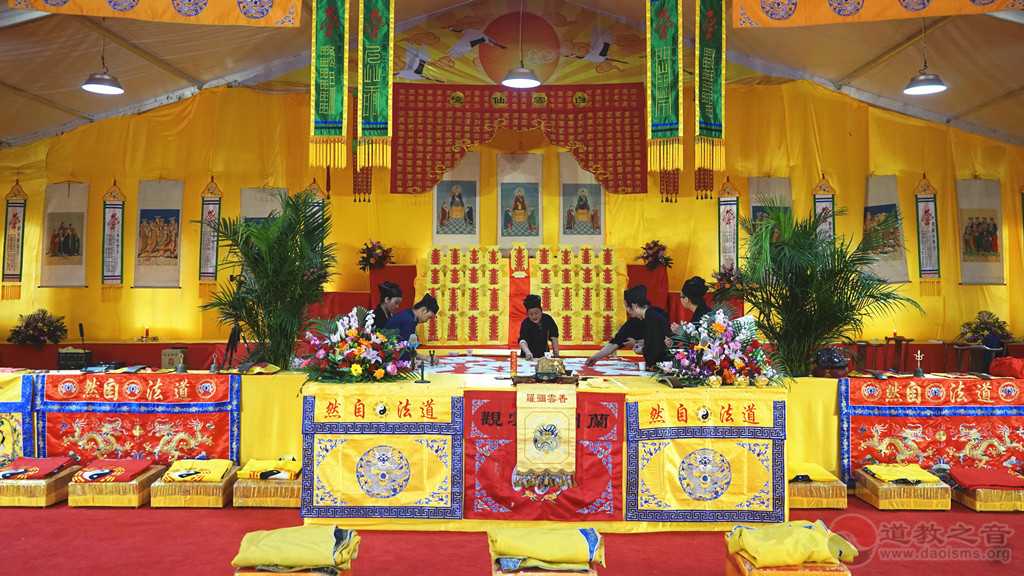
(1) Morning and Evening Altar Lessons
This is a regular ritual performed by Taoists residing in temples every morning and evening, likely originating after the Southern and Northern Dynasties. As stated in the Preface to the Morning and Evening Lesson Sutras, “Lessons refer to practicing merits. They involve cultivating one’s own merits and nurturing one’s own Dao. Those who cultivate their own Dao rely on the classics of ancient sages. By reciting the golden books and jade edicts of noble sages, one gains insight into one’s own true nature and sincere heart. Without religious instruction, the great Dao cannot be propagated; without lesson recitation, the primordial harmony cannot be preserved. It serves as the gateway to entering the Dao and the path to cultivating immortality.”
Taoist practitioners residing in temples attend daily devotional sessions at Mao Shi (approximately 5 – 7 a.m.) and You Shi (around 5 – 7 p.m.). During the morning service, they intone the Incense Praises, Sutra Opening Verses, Pure Heart Mantra, Pure Mouth Mantra, Pure Body Mantra, along with The Scripture of Clarity and Tranquility and The Marvelous Scripture of the Jade Emperor’s Heart Seal. In the evening, they recite the Buxu Incantation, additional Sutra Opening Verses, Mysterious Meaning Mantra, The Supreme Cavernous Mystery Numinous Treasure Scripture for Relieving Suffering and Removing Sins, and The True Scripture of the Primordial Celestial Worthy on Ascending to Heaven and Attaining the Dao. The practices of hymn – singing, ritual veneration, and scriptural chanting fulfill five key functions: cultivating spiritual truth and nurturing the inner nature, invoking blessings and auspiciousness, fortifying one’s commitment to the Daoist path, liberating the souls of the departed, and upholding the moral and spiritual ethos of the temple.
(2) Zhu Jiang Ritual
This is a ritual commonly performed at the conclusion of morning altar lessons in Taoism. “Zhu” means respectfully inviting, and “Jiang” refers to divine beings; Zhu Jiang is the act of respectfully welcoming divine beings to the altar.
After the morning altar lessons transform the heaven and earth documents, through the Gaogong’s (high priest’s) declaration, holding up the Wei Xian Hua Tianzun, worshipping, offering incense, announcing the memorial, and reciting mantras, the majestic spiritual power of the ancestors is manifested, descending upon the altar to protect the scriptures, the Dao, and the altar court, thereby ensuring the eternal purity of the Daoist community.
(3) Ji Gu Ritual
This is a ritual commonly performed at the conclusion of evening altar lessons in Taoism. “Ji” means sacrificing and delivering, and “Gu” refers to lonely souls; Ji Gu involves sacrificing to lonely souls and delivering the deceased.
When concluding the evening altar lessons, after each deacon acts in accordance with the rituals, through the Gaogong’s declaration, holding up the Taiyi Jiuku Tianzun, worshipping, offering incense, sprinkling pure water, the declarer announcing the memorial records, and the Gaogong stepping on the gang (celestial steps) and scattering food, it is hoped that nectar will open the gates of hell, allowing lonely souls and the deceased to ascend to the immortal capital.
(4) Birthday Celebration Ritual
This is a ritual used by Taoism to mark the birthdays of ancestral masters. “Zhu” means celebrating, and “Shou” means birthday; thus, this ritual is held to celebrate the birthdays of ancestral masters. For instance, the 9th, 15th, and 19th days of the first lunar month are the birthdays of the Jade Emperor, the Heavenly Official, and Qiu Zu respectively. This ritual is performed at midnight on these days to celebrate the birth of the ancestral masters.
Its procedures are as follows: each deacon acts with dignity and in accordance with the rituals; the Gaogong makes a declaration; all collectively hold up the Xuan Jiao Wan Shou Tianzun; they offer incense and sing praises; hold up the Dao Jing Shi Bao Tianzun; chant the rhyme of “Three Treasures Incense”; hold up the Xiang Yun Da Xin Tianzun; announce the memorial and recite the ancestral master’s precious proclamation (reciting the proclamation of the specific ancestral master on their birthday); burn the memorial; and then retreat.
(5) Celebration Ritual
This is also a ritual used by Taoism to mark the birthdays of ancestral masters. “Qing” means celebrating, and this ritual is held to celebrate the birthdays of ancestral masters, usually during the day on the birthday.
Its procedures are: each deacon lines up and acts in accordance with the rituals; they offer incense and sing praises; hold up the San Qing Ying Hua Tianzun; hold up the Dao Jing Shi Bao Tianzun; hold up the Xiang Yun Da Xin Tianzun; recite the incense blessing mantra; recite the Wei Ling mantra; announce the memorial; make a declaration; recite the proclamation (reciting the proclamation of the specific ancestral master on their birthday); burn the memorial; and then retreat.
Through this ritual, they respectfully face the Jiao altar to celebrate the birthday of the ancestral masters.
(6) Receiving the Divine Chariot Ritual
This is a ritual specifically used by Taoism on the morning when the Jade Emperor patrols the heavens. “Jie” means welcoming, and “Jia” refers to the divine chariot, i.e., the Jade Emperor; this ritual is the court ceremony performed when welcoming the Jade Emperor. Taoist temples hold a grand ceremony to welcome the Jade Emperor’s divine chariot at midnight (0 o’clock) on the 25th day of the twelfth lunar month, referred to as “welcoming the imperial carriage.”
Its procedure is: after reciting The Supreme Numinous Treasure 天尊’s Sutra on Averting Disasters and Relieving Misfortune in the Morning Lessons, the Gaogong kneels and rises to chant the invitation rhyme, starts the “small praise rhyme”; the abbot offers incense and strikes the board; the Gaogong speaks; the Ti Ke starts the Buxu rhyme; the Gaogong holds up the Da Luo San Bao Tianzun; the Gaogong starts the hanging; the Gaogong outlines; a declaration is made; the Gaogong speaks and starts the Tianzun board; everyone recites the He Jia Cai Lin Tianzun; all leave the hall and proceed to the Heavenly Altar; and then retreat.
Through this ritual, they respectfully face the jade altar, inviting the Jade Emperor to descend to the mortal world, bestow blessings, avert disasters, and prolong life.
(7) Great Repentance Ritual
This is a ritual commonly performed at the conclusion of a Taoist ceremony, serving as a general repentance for the completion of the ceremony.
Its procedures are: the Gaogong offers incense and speaks; the Ti Ke starts the step text; the Gaogong holds up the Da Luo Bao Tianzun; the Gaogong starts the hanging; the Ti Ke mentions “respectfully facing the Dao”; the declarer responds “repentance according to the law”; the Gaogong reads the repentance text aloud; everyone recites The Precious Proclamation of Mi Luo and The Collection Sutra of the Cave Mysterious Numinous Treasure Supreme Jade Emperor’s Original Deeds; the Gaogong starts the flower-sending praise; and then retreats.
Through this ritual, relying on the power of the Dao, they wish to eliminate sins, continuously turn the Dharma wheel, and universally deliver all beings.

(8) Presenting Memorials Ritual
Presenting memorials, also known as “transforming memorials” or “burning documents,” is a crucial ritual in Taoist Zhaijiao, widely used in various large-scale Zhaijiao activities. For example, it is performed in Jinlu, Yulu, Huanglu rituals, or large Jiao gatherings.
Presenting memorials originated from ancient Chinese prayer rituals. After evolving through the Han, Wei, Southern and Northern Dynasties, Sui, and Tang Dynasties, it gradually became more elaborate from simple forms, and became unified and refined after the Song and Yuan Dynasties. However, due to differences in the inheritance of Daoist methods, as well as variations in the economy, culture, language, and customs of the regions where it spread, there are significant differences in its practice across different places. For instance, the current “presenting memorials” ritual in Shanghai Taoism generally consists of three steps. The first step is opening the altar: the master and all Taoists enter the altar to offer incense and kneel in prayer; the Jiao altar is transformed into a jade altar wonderland; all lamps in the altar are lit using the lamp distribution method; the sounds of gold and jade are struck; then they rinse their mouths and purify the altar by sprinkling water. The second step is inviting the saints: enshrining the sacred beings of the five directions, inviting the saints, and welcoming their descent. The third step is worshipping the memorials: the master and all Taoists invite the three teachers to assist, descending to the altar; the Gaogong silently recites the “incense burning mantra” and performs sacrifices to the immortal officials in charge of memorials, requesting them to deliver the memorials to the heavenly court; then the memorials are sealed, with the master virtually drawing talismans on them to signify sealing; the ceremony of sending the memorials is performed, with the memorials burned to send them on their way; the Gaogong performs gang steps and treads the Big Dipper pattern to symbolize the primordial spirit ascending to the heavenly court, silently reciting the memorials and reporting to the heavens. After treading the memorials, the Gaogong gathers the primordial spirit; all masters and deacons thank all the gods, offer tributes, and the presentation of memorials concludes with a retreat to the hall. This is the core content of the presenting memorials ritual.
Through this ritual, Taoists present the memorials written with the wishes of believers to the heavenly court, reporting to the heavens. All saints descend to the altar, bestowing blessings and prolonging life, with ancestors being delivered.
(9) Water and Fire Refining and Delivering Ritual
This is a commonly used ritual in Taoist Zhaijiao. Water and fire here refer to true water and true fire; Water and Fire Refining and Delivering involves using true water and true fire to jointly refine the souls of the deceased and deliver wandering spirits. There are three types: nine refinings of the living corpse, Lingbao refining and delivering, and Nanchang refining and delivering.
When performing this ritual, a water pool and a fire pond are set up on the altar. The water pool contains true water, and the fire pond contains true fire. True water is “taken from the east well before anyone draws water” at dawn (The Great Method of the Supreme Numinous Treasure). After burning the water-inviting talismans, water is drawn into the pool by candlelight. True fire is obtained “by facing the sun at noon, cutting bamboo to make fire, and using seal incense to ignite it from below” (ibid.). After the fire is lit, fire-inviting talismans are burned to ignite the charcoal in the pond.
Its procedures are: offering incense, informing the Supreme Lord, burning the talismans of descending true edicts; the Gaogong takes his seat to summon the generals and officials, who then descend; reciting the true names of the five emperors; gathering and summoning the souls of the deceased, refining them jointly with water and fire; burning nine chapters of talismans to enable the souls’ internal organs to generate spirits; preaching precepts; holding up the Dao Jing Shi Bao; reciting the ten precepts for ghosts and gods; reciting the nine true wonderful precepts; holding up the praise of abiding by precepts; reading the talismans and announcing the documents; the Gaogong steps down to send the souls across the bridge; burning offerings, holding up the San Qing music; and retreating. Its core is gathering and summoning the souls of the deceased and refining them jointly with water and fire.
Through this ritual, water and fire jointly refine, transcending the yin realm and delivering the deceased.
(10) Lamp Ritual
This is a commonly used ritual in Taoist Zhaijiao, referring to a ritual where lamps are the main ritual tools, mostly held after sunset. There are Jiu You lamp ritual, Big Dipper lamp ritual, natal lamp ritual, Blood Lake lamp ritual, etc.
The lamp ritual originated from ancient Chinese sacrificial and prayer rituals. By the Southern and Northern Dynasties, there was a “lamp attendant” position among the deacons of the Jiao altar. By the late Tang and Five Dynasties, a complete lamp-worshipping ritual had emerged in Taoist Zhaijiao. During the Yuan Dynasty, the lamp ritual was widely used in Jinlu and Yulu Taoist ceremonies. Over time, it generally divided into two categories: Jinlu and Huanglu.
The procedure of the Jinlu-type lamp ritual is: entering the altar, opening and explaining (conveying intentions), returning to life and praising, chanting scriptures, announcing the document, and repenting.
The procedure of the Huanglu-type lamp ritual is: entering the altar, opening and explaining (conveying intentions), holding up the title of Tianzun and praising, chanting scriptures, announcing the document, and repenting.
The fire source in the lamp ritual is obtained from the noon sun, which is then used to light all the lamps in the altar during the ritual.
Through this ritual, light shines on all heavens, continues to dispel darkness, connects to the Jiu You hell below, and reflects the Wufu Jitang above.
