
The formation of Taoism is a long process of cultural accumulation, and its origin can be traced back to the Taoist thought of the pre-Qin period. Laozi’s “Tao Te Ching” put forward the cosmic view that “Tao gives birth to one, one gives birth to two, two gives birth to three, and three gives birth to all things”, regarding “Tao” as the origin of all things in heaven and earth. This thought has become the core theoretical cornerstone of Taoism. The Huang-Lao school during the Warring States period (represented by Huangdi and Laozi) further integrated the Yin-Yang and Five Elements theory with the way of health preservation, laying the groundwork for the immortal belief of Taoism.

During the Eastern Han Dynasty, Taoism gradually evolved from a philosophical thought into an organized religion. Zhang Daoling founded the “Five Pecks of Rice Tao” in Heming Mountain, Sichuan, with “Annotations on Laozi as Thought” as the classic, and established twenty-four zhi (religious activity venues), which marked the official formation of the Taoist system. During the same period, Zhang Jiao organized the people with “Taiping Tao” and put forward the slogan “The blue sky has died, and the yellow sky will stand”. Although the Yellow Turban Uprising he launched failed, it promoted the widespread spread of Taoism among the people.
During the Wei, Jin, Southern and Northern Dynasties, Taoism gradually matured. Ge Hong’s “Baopuzi” systematically sorted out alchemy and immortal theories, and Tao Hongjing’s “True Spiritual Position and Industry Map” constructed the immortal genealogy of Taoism, making the Taoist belief more systematic. In the Tang and Song dynasties, Taoism reached its peak due to the admiration of the royal family. Not only were Taoist temples all over the country, but its ideas also penetrated into national systems such as the imperial examination and etiquette. After the Ming and Qing dynasties, although Taoism gradually became popular among the people, its influence on folk culture became more and more profound. The marks of Taoism can be seen in customs such as offering sacrifices to the kitchen god during the Spring Festival and hanging mugwort during the Dragon Boat Festival.

The essence of Taoist culture is concentrated in the cognition and practice of “Tao”. In Taoism’s view, “Tao” is an invisible and formless but omnipresent cosmic law. It is manifested not only as the natural law of the rotation of the four seasons but also as the life rhythm of the growth and decline of Yin and Yang. Therefore, “following nature” has become the most fundamental code of conduct for Taoism – just as the story of “Butcher Ding Dissecting an Ox” in “Zhuangzi” reveals, when people’s actions are in line with the essential laws of things, they can reach the free state of “handling things with ease”.
“Yin-Yang balance” is another key to Taoism’s understanding of the world. This thought holds that everything in the universe contains two sides of Yin and Yang that are interdependent and mutually restrictive, such as heaven is Yang, earth is Yin, male is Yang, and female is Yin. The human body, as a “small universe”, also needs to maintain the harmony of Yin and Yang. Once unbalanced, diseases will occur. Based on this theory, Taoist medicine regulates the human body’s balance through acupuncture, traditional Chinese medicine, Daoyin, etc. This holistic view coincides with modern preventive medicine.

At the level of life practice, Taoism emphasizes “cultivating both nature and life”. “Nature” refers to the cultivation of the mind and morality, advocating the purification of the mind through few desires and keeping quiet, just as “Tao Te Ching” says “Reach the extreme of emptiness, and maintain the utmost tranquility”; “Life” refers to the body and life functions, advocating prolonging life through alchemy and health preservation. This concept, which attaches importance to both the improvement of the spiritual realm and the maintenance of physical health, has formed a unique view of life and also gave birth to health-preserving methods such as Tai Chi and Baduanjin that have been passed down to this day.
The inheritance of Taoist culture is inseparable from rich carrier forms. In terms of classics, the series of books called “Daozang” collects the classic documents of Taoism, covering various fields such as philosophy, religion, and science and technology. Among them, “Tao Te Ching”, “Zhuangzi” and “Zhouyi Can Tong Qi” are regarded as core classics, which not only have guiding significance for Taoists but also profoundly influence Chinese literary and artistic creation – the heroism in Li Bai’s poems such as “The great Tao is like the blue sky” and the empty artistic conception reflected by “leaving blank” in landscape paintings can all show the shadow of Taoist thought.
Taoism’s ritual system is also unique. Zhaijiao ceremonies, as the most important religious rituals of Taoism, express respect and prayers to the gods through such links as burning incense, reciting scriptures, and stepping on the gang and fighting. Different rituals have different functions, such as “prayer Zhai” for praying for peace and “salvation Zhai” for remembering ancestors. Although these rituals seem complicated, they actually contain the profound meaning of “achieving unity with Tao through orderly behavior”. Their sense of solemnity interacts with art forms such as drama and music, forming a unique Taoist art.
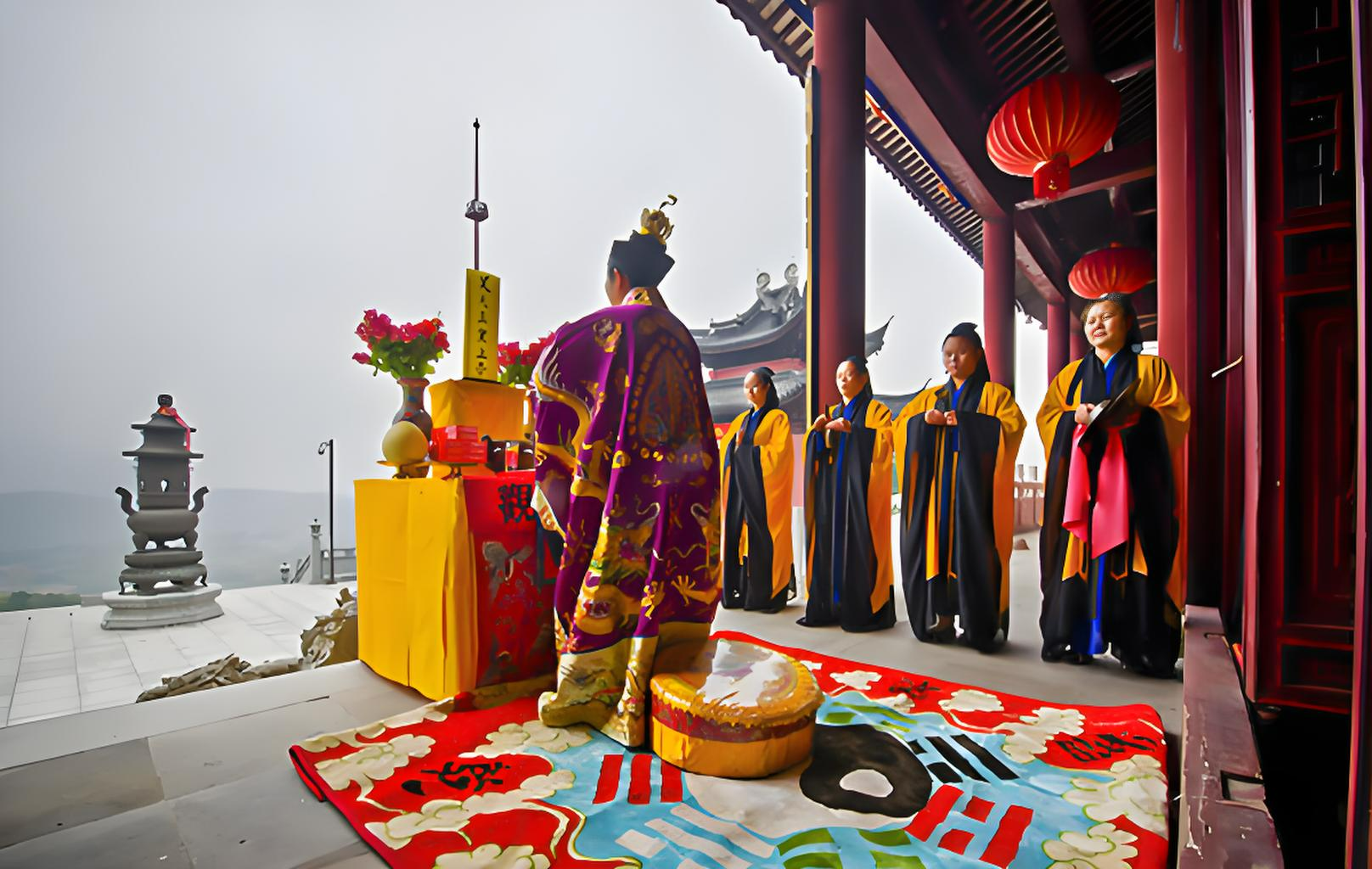
In terms of utensils, Taoism has created many items with symbolic significance. The peach wood sword is believed to be able to exorcise evil spirits, derived from the ancient belief that “peach is the essence of the five trees”; the compass is not only a tool for feng shui but also reflects Taoism’s cosmic view of “correspondence between heaven and man”; and the alchemy furnace has witnessed Taoism’s exploration of material transformation. The chemical knowledge accumulated in the process has made unique contributions to the development of ancient Chinese science and technology.
In today’s world with rapid development of science and technology, Taoist culture can still provide us with important enlightenment. Its concept of “harmony between man and nature” reminds people to respect the laws of nature while developing the economy, which coincides with the contemporary environmental protection thought; the way of self-cultivation of “few private desires” provides a good prescription for dealing with the spiritual anxiety brought by consumerism; and the popularization of health-preserving methods such as Tai Chi allows more people to find the fulcrum of physical and mental balance in the fast-paced life.
The Taoist culture spread by our platform always adheres to the attitude of “taking its essence and discarding its dross”. Whether it is the interpretation of classics or the introduction of health-preserving methods, we strive to get rid of superstitious colors and present the philosophical wisdom and life wisdom behind it. As Taoism advocates “Tao is in daily use”, the vitality of traditional culture does not lie in the textual research in the pile of old papers, but in whether it can find new growth points in contemporary life.
From Laozi riding a cow out of Hangu Pass and leaving five thousand words to the figure of old people playing Tai Chi in the park today, Taoist culture has been constantly renewing itself in the long river of history. It tells us that the real tradition is not a rigid dogma, but a source of wisdom that can cross time and space and respond to the eternal needs of human beings. When we approach it with an open mind, we can find a new coordinate for settling modern life in the ancient “Tao”.
