
FIVE ELEMENTS
The theory of the Five Elements is a highly influential core concept in ancient Chinese philosophy. It does not simply refer to five specific substances but uses wood, fire, earth, metal, and water as symbols to summarize the laws and interrelationships governing the operation and changes of all things in the universe. It was an important thinking tool for ancient people to understand the world and explain natural and social phenomena. The following is a detailed elaboration from multiple dimensions:
Origin and Development of the Five Elements:
Origin: The earliest systematic record of the term “Five Elements” is found in Shangshu·Hongfan (The Book of Documents·The Great Plan), an important pre-Qin classic. It clearly puts forward, “The Five Elements: first, water; second, fire; third, wood; fourth, metal; fifth, earth. Water is characterized by moistening and descending; fire by burning and ascending; wood by bending and straightening; metal by following and transforming; earth by sowing and reaping.” At this time, the concept of the Five Elements was more inclined to the cognition of five basic material elements in nature, representing the early exploration results of ancient people on the composition of the material world.
Development: In the late Western Zhou Dynasty, the thinker Shi Bo, when discussing the way of governing a country, put forward, “Harmony produces things, while sameness leads to stagnation. Balancing different things is called harmony, so it can promote growth and gather things. If you just add the same to the same, everything will eventually be abandoned. Therefore, the former kings mixed earth with metal, wood, water, and fire to form all things.” He was the first to regard the Five Elements as the basic materials composing all things, using the theory of the intermixture of the Five Elements to explain the diversity and complexity of the material world, and promoting the thought of the Five Elements from a simple list of substances to philosophical speculation. During the Spring and Autumn Period, the idea of mutual conquest (i.e., mutual restriction) among the Five Elements began to emerge. Shi Mo, a senior official of the State of Jin, once predicted the outcome of a war based on the theory that “water conquers fire,” showing that the theory of the Five Elements had begun to be applied to the analysis of social phenomena. In the Warring States Period, Zou Yan, a representative figure of the Yin-Yang school, combined the thought of the Five Elements with social and historical changes and put forward the theory of “the succession of the Five Virtues.” He believed that each dynasty corresponded to a kind of “virtue” (i.e., the virtue of one of the Five Elements), and the replacement of dynasties followed the law of mutual conquest of the Five Elements. For example, the Xia Dynasty corresponded to the virtue of wood, the Shang Dynasty to the virtue of metal (metal conquers wood), and the Zhou Dynasty to the virtue of fire (fire conquers metal), etc. This expanded the Five Elements from the natural field to the social and historical field, making it a theoretical tool to explain the rise and fall of dynasties. In the Western Han Dynasty, Dong Zhongshu constructed a more complete system of the Five Elements in Chunqiu Fanlu (Luxuriant Gems of the Spring and Autumn Annals). He not only clearly put forward the theory of “mutual generation of the Five Elements” but also systematically associated the Five Elements with the four seasons, directions, and human affairs, such as “wood is on the left, metal on the right, fire in the front, water at the back, and earth in the center.” He also endowed the Five Elements with ethical connotations, gradually making the thought of the Five Elements religious and theological, and an important part of his system of “the interaction between heaven and man.” During the Eastern Han Dynasty, the official classic Baihu Tongyi (Comprehensive Meaning of the White Tiger Hall) further strengthened the theological color of the Five Elements, linking them with social hierarchical order such as monarch and minister, father and son, and ethical behaviors. For example, ethical norms like “the father is the guide of the son, and the elder brother is the guide of the younger brother” were all given the basis of the Five Elements, making the theory of the Five Elements a thought tool to maintain the feudal hierarchical system. Confucian scholars in the Song Dynasty were committed to endowing the theory of the Five Elements with deeper philosophical significance. Zhou Dunyi, in Taiji Tushuo (Explanation of the Diagram of the Supreme Ultimate), regarded the Five Elements as an important link in the evolution of the universe, putting forward that “the Supreme Ultimate produces the Two Modes, the Two Modes produce the Four Images, the Four Images produce the Eight Trigrams, the Eight Trigrams determine good and bad fortune, and good and bad fortune lead to great undertakings,” and the Five Elements were the material basis formed in the evolution process of the Supreme Ultimate and Yin-Yang. Zhu Xi believed that the Five Elements were “the circulation of Yin and Yang qi between heaven and earth” and the different manifestations of Yin and Yang qi with specific forms and qualities. He incorporated the Five Elements into the cosmological system of Neo-Confucianism, making them one of the core concepts to explain the origin and development laws of the world.
Characteristics of the Five Elements:
Wood: The core characteristic is “quzhi” (bending and straightening), originally referring to the fact that the branches of trees can both bend (qu) and straighten (zhi), with the characteristics of natural growth and soft form. By extension, all things and phenomena with the nature or function of growth, upward development, smoothness, and ease are attributed to wood. For example, the revival of all things and the growth of plants in spring embody the upward-developing characteristic of wood; a person’s comfortable mood and smooth flow of qi are also in line with the characteristic of wood. In nature, the flow of wind and the photosynthesis of plants are all considered to contain the energy of wood.
Fire: The basic characteristic is “yanshang” (burning and ascending). “Yan” means hot and bright, and “shang” means upward and rising, which accurately summarizes the essential characteristics of fire as being hot, ascending, and bright. By extension, all things and phenomena with the nature or function of being warm, rising, bright, and active are attributed to fire. The high temperature and heat in summer, the bright sunshine, the maintenance of human body temperature, and the excitement of emotions are all related to the characteristic of fire. At the energy level, fire represents a positive and upward trend of releasing energy.
Earth: The main characteristic is “jiasai” (sowing and reaping). “Jia” refers to sowing grains, and “sai” refers to harvesting grains, which centrally reflects that earth has the function of nurturing, carrying, and growing all things. By extension, all things and phenomena with the nature or function of generating and transforming, carrying, receiving, and nurturing are attributed to earth. The earth carrying all things, the soil nurturing crops, and the human spleen and stomach digesting and absorbing nutrients to nourish the whole body are all specific manifestations of the characteristic of earth. Earth is in the central position among the Five Elements, with the function of harmonizing the four directions and connecting the upper and lower parts, and is regarded as the basis for the growth of all things.
Metal: The characteristic is “congge” (following and transforming). “Cong” means obeying and submitting, and “ge” means changing and reforming. Together, they indicate that metal can both change its form in accordance with external forces (such as metal can be forged) and has the characteristics of being hard and stern. By extension, all things and phenomena with the nature or function of descending, sternness, astringency, cleanness, and transformation are attributed to metal. The withering of plants in autumn (sternness), the cooling of the weather (astringency), the cutting of metal tools (transformation), and the descending function of the human lungs are all in line with the characteristic of metal. The characteristic of metal also embodies an orderly astringency and regulatory role.
Water: The core characteristic is “runxia” (moistening and descending). “Run” means moistening and nourishing, and “xia” means downward and sinking, describing the natural attribute of water to moisten all things and flow downward. By extension, all things and phenomena with the nature or function of moistening, descending, coldness, storage, and collection are attributed to water. The cold storage in winter, the downward flow of rivers, the essence-storing function of the human kidneys, and the quiet rest at night all embody the characteristic of water. Water is regarded as the source of life, and its moistening effect is a necessary condition for the growth of all things, while its storage characteristic accumulates energy for the regeneration of things.
Mutual Generation and Conquest of the Five Elements:
Mutual Generation of the Five Elements: It refers to an orderly, dynamic relationship of mutual generation, promotion, and assistance among the Five Elements. This relationship is like the mutual generation between mother and child, interlocking and forming a cyclical energy chain. The specific order is: wood generates fire – wood can burn to produce fire, so wood is the mother of fire, and fire is the child of wood; fire generates earth – the ashes after fire burns can turn into earth, so fire is the mother of earth, and earth is the child of fire; earth generates metal – metal minerals are mostly hidden in the soil, so earth is the mother of metal, and metal is the child of earth; metal generates water – anciently, it was believed that metal could condense into water droplets in cold weather (such as iron tools condensing dew when cold), so metal is the mother of water, and water is the child of metal; water generates wood – water is a necessary condition for the growth of trees, so water is the mother of wood, and wood is the child of water. This mutual generation relationship maintains the balance and development of the Five Elements system, enabling all things to grow and reproduce endlessly.
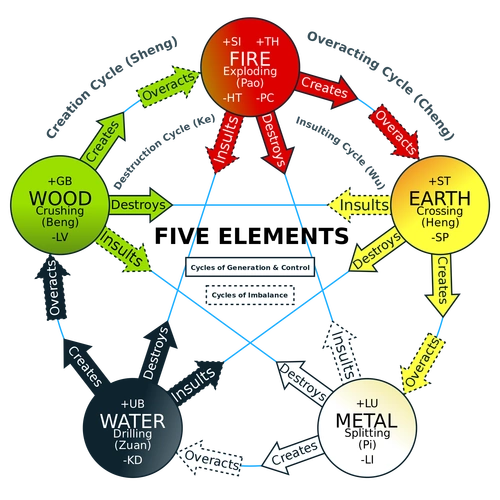
Mutual Conquest of the Five Elements: It refers to an orderly relationship of mutual restraint and restriction among the Five Elements. This relationship is like a checks-and-balances mechanism in nature, preventing one element from becoming overly dominant to maintain the stability of the system. The specific order is: wood conquers earth – the roots of trees can penetrate the soil, restricting the excessive agglomeration of earth, so wood can conquer earth; earth conquers water – soil can block the flow of water and play a role in controlling water, so earth can conquer water; water conquers fire – water can extinguish flames, so water can conquer fire; fire conquers metal – the high temperature of fire can melt metal, so fire can conquer metal; metal conquers wood – metal tools can cut down trees, so metal can conquer wood. The conquest relationship is not an absolute suppression but a moderate restriction, preventing any of the Five Elements from overdeveloping, thus maintaining the overall balance.
Kangcheng (Excessive Conquest) and Fanwu (Reverse Conquest): The Five Elements maintain a dynamic balance through generation and restriction. When an element’s power deviates—either overly strong or weak—this balance breaks, causing “kangcheng” and “fanwu”.
- Kangcheng: An element’s excessive strength leads to over-restraint of its conquered element. For instance, “wood kang cheng earth” occurs when robust wood energy over-restrains earth, potentially causing soil infertility and spleen-stomach dysfunction.
- Fanwu: The conquered element counteracts the conqueror due to the conqueror’s excess or its own weakness. In “wood kang wu metal”, strong wood overcomes weak metal, seen in forests hindering metal tool use and liver qi overtaxing lung qi in the body. “Metal decline wood wu” shows that even normal wood can reverse-conquer extremely weak metal.
Corresponding Relationships Between the Five Elements and Things:
Five Seasons: Wood corresponds to spring because all things grow in spring, which is consistent with the upward-developing characteristic of wood; fire corresponds to summer because summer is hot and bright, consistent with the burning and ascending characteristic of fire; earth corresponds to long summer (i.e., the last month of summer, approximately the sixth lunar month) because the climate is humid and hot at this time, and all things are gestating and maturing, consistent with the generating and transforming, carrying characteristic of earth; metal corresponds to autumn because plants wither in autumn and the climate is stern, corresponding to the astringent and stern characteristic of metal; water corresponds to winter because winter is cold and storage-oriented, and all things hibernate, consistent with the moistening and descending, storage characteristic of water.

Five Directions: Wood corresponds to the east. The east is the direction where the sun rises, symbolizing growth and upward development, consistent with the nature of wood; fire corresponds to the south. The south has a hot climate and abundant sunshine, consistent with the warm characteristic of fire; earth corresponds to the center. The center is the core of the earth, carrying all things in the four directions, consistent with the central carrying characteristic of earth; metal corresponds to the west. The west is the direction where the sun sets, symbolizing astringency and descending, corresponding to the nature of metal; water corresponds to the north. The north has a cold climate and all things are in storage, consistent with the cold and storage characteristic of water.
Five Zang-Organs: Wood corresponds to the liver. The liver has the functions of dredging qi and promoting growth, similar to the smooth characteristic of wood; fire corresponds to the heart. The heart governs blood vessels and consciousness, being the master of human life activities, providing energy and light like a flame, consistent with the nature of fire; earth corresponds to the spleen. The spleen governs transportation and transformation, being able to digest and absorb the essence of food and transport it to the whole body, like the earth nurturing all things, consistent with the generating and transforming, carrying characteristic of earth; metal corresponds to the lung. The lung governs qi and respiration, with the functions of dispersing and descending, consistent with the astringent and descending characteristic of metal; water corresponds to the kidney. The kidney governs storing essence, being the congenital foundation of the human body, with the function of storing essence and nourishing the whole body, consistent with the moistening and descending, storage characteristic of water.
Five Fu-Organs: Wood corresponds to the gallbladder. The gallbladder is attached to the liver and has the function of storing and excreting bile. The excretion of bile depends on the dredging function of the liver, which is related to the smooth characteristic of wood; fire corresponds to the small intestine. The small intestine has the functions of receiving and transforming food, separating clear and turbid, being able to absorb the essence of water and grains and excrete the dregs. Its functional activities depend on the promotion of the heart’s yang qi, consistent with the nature of fire; earth corresponds to the stomach. The stomach governs receiving and digesting food, cooperating with the spleen to complete the digestive function, like the earth containing all things, consistent with the nature of earth; metal corresponds to the large intestine. The large intestine has the functions of transmitting dregs and absorbing water, and its transmission function depends on the descending effect of the lung, consistent with the astringent characteristic of metal; water corresponds to the bladder. The bladder has the functions of storing and excreting urine, and the production and excretion of urine depend on the qi transformation function of the kidney, consistent with the nature of water.
Five Sense Organs: Wood corresponds to the eyes. The liver opens into the eyes, and the visual function of the eyes depends on the nourishment of liver blood, which is related to the upward-developing and smooth characteristic of wood. For example, sufficient liver blood makes the eyes bright; fire corresponds to the tongue. The heart opens into the tongue, and the taste function and language expression of the tongue depend on the nourishment of the heart’s qi and blood, consistent with the bright and active characteristic of fire. For example, excessive heart fire makes the tip of the tongue red; earth corresponds to the mouth. The spleen opens into the mouth, and the taste function of the mouth is closely related to the transportation and transformation function of the spleen. A normal spleen function leads to a balanced taste, consistent with the generating and transforming characteristic of earth; metal corresponds to the nose. The lung opens into the nose, and the olfactory function of the nose depends on the smooth flow of the lung’s qi, consistent with the dispersing and descending characteristic of metal. For example, smooth lung qi makes the sense of smell sensitive; water corresponds to the ears. The kidney opens into the ears, and the hearing function of the ears depends on the nourishment of kidney essence. Sufficient kidney essence makes hearing sensitive, consistent with the nature of water.
Five Colors: Wood corresponds to cyan (including blue, green, etc.). Cyan symbolizes the vitality of plant growth, consistent with the upward-developing characteristic of wood; fire corresponds to red. Red symbolizes the warmth and brightness of flame, consistent with the nature of fire; earth corresponds to yellow. Yellow is the color of the earth, symbolizing thickness and carrying, consistent with the nature of earth; metal corresponds to white. White symbolizes cleanliness and sternness, such as the frost and snow in autumn and the luster of metal, consistent with the nature of metal; water corresponds to black (including deep cyan, dark color, etc.). Black symbolizes depth and storage, such as the dark night in winter and deep water, consistent with the nature of water.