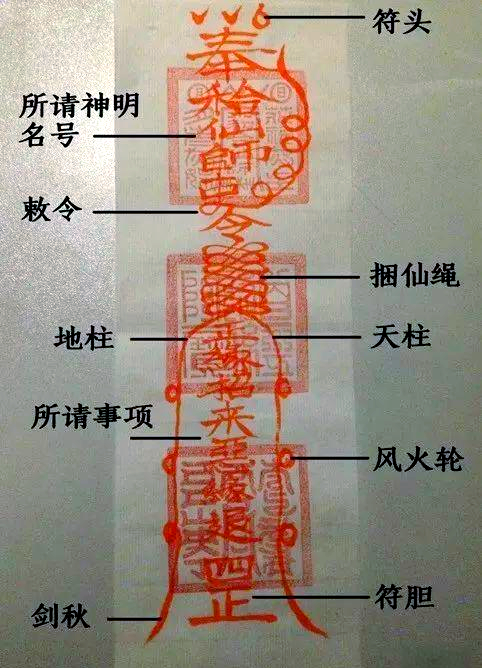
The head of a talisman is often represented by three hooks, symbolizing sacred beings such as the Three Pure Ones and the Three Terraces Star Lords. This design element will be elaborated in detail in the subsequent content. Meanwhile, the forms of the talisman head are diverse, with many variations.


In a talisman, immediately following the characters “奉” (fèng) or “勅” (chì), the name of the presiding deity or ancestral master is often revealed. For instance, in the aforementioned talisman, the presiding deity is the Maoshan Ancestor.


As shown in the figure, the “frame edges” here are also called “Tianzhu (Heavenly Pillar), Dizhu (Earthly Pillar)” or “Talisman Frame” in some sects. Among them, “Tianzhu” is located on the left, symbolizing the heaven; “Dizhu” is located on the right, representing the earth. These names all reflect the awe and respect for the gods of heaven and earth when writing talismans.

In the culture of talismans and incantations, the character “罡” (gang) plays an important role. It is sometimes used as a trigram-initiating talisman frame (talisman foot), where some important contents of the talisman’s core are written. However, not all “罡” characters in talismans perform such a function; sometimes it merely serves as a part of the overall structure, rather than being specifically used for writing the talisman frame or core.

In the culture of talismans and incantations, as the concluding part of a talisman, the talisman frame not only undertakes the important mission of ending the talisman but also serves as a key position for writing the talisman’s core. It is like the “source of power” of the entire talisman, symbolizing specific actions or meanings. However, due to differences in various sects and styles, the design of the talisman frame also varies. Some sects will add the talisman’s core to the talisman frame, forming a special painted dot, such as the character “罡” (gang); while others may choose not to include or omit the talisman’s core, leaving the corresponding position blank or uncolored. In addition, common talisman frame designs include many variants such as “Yingang” (印罡), “Huogangdou” (火罡斗), “Yu” (御), “Jing” (井), and the one shown in the above figure.

In the culture of talismans and incantations, many talismans incorporate special contents known as “talisman cores”. These not only add profound meanings to the talismans but also endow them with specific functions and significances. However, due to the lack of specific examples, we cannot elaborate on the specific forms of talisman cores here. Taking the Wealth-Attracting Talisman of the Five Directions Evil Gods as an example, the talisman core on it embodies the characteristics and profound implications of the Taiwan Maoshan tradition. This talisman carries the order of the founder of Maoshan, summoning the Five Directions Evil Gods to bring wealth and treasures to people. Its meaning and efficacy are clear at a glance, reflecting the distinctive feature of the southern-transmitted talisman culture: clearly writing the tasks and purposes to be performed on the talisman.