
When those twisted and coiled mysterious symbols in ancient books come into view, and when the yellowed talismans on the lintels of traditional residences quietly catch the eye, do you ever wonder: what kind of cultural codes are hidden behind these seemingly abstract patterns and texts? As an important carrier of Taoist culture, Taoist talismans are not only a bridge for ancient people to communicate with heaven and earth but also a spiritual sustenance for settling the body and mind. They are by no means simple superstitious symbols, but a kind of life wisdom embodying the concept of “harmony between man and nature”. Even in the contemporary era, they still nourish people’s spiritual world in a unique way.
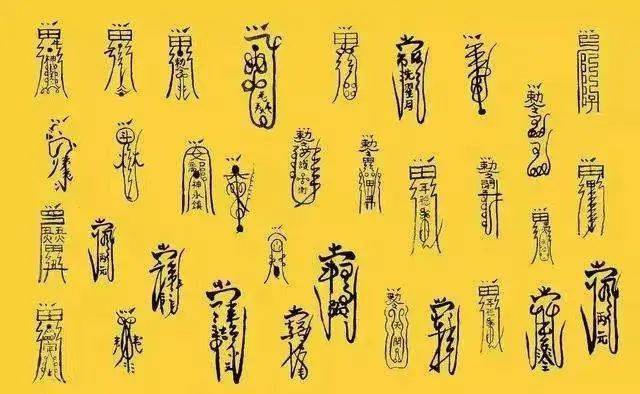
The amulet is one of the most widely circulated talismans. It is small and portable, often made into pendants, sachets, and other forms. Such talismans are mostly based on patterns such as the Eight Trigrams and the Big Dipper, paired with “imperial order” runes, aiming to build an invisible protective barrier for the wearer. Traditionally, amulets need to be hand-painted by Taoists with cinnabar. When painting, they recite the incantation of “inviting gods to protect”, and after completion, they need to be fumigated with incense to “activate” the energy. Modern research has found that this wearing behavior actually contains a positive psychological suggestion effect, like a “spiritual anchor” carried with you, giving people spiritual comfort when facing uncertainty.

The house-protecting talisman is like an “energy security system” for the home, specially dealing with negative energy fields in the living environment. The “Five Mountains Talisman” recorded in the ancient book Ten Books on Yangzhai suppresses evil spirits through patterns symbolizing the Five Great Mountains, and is especially suitable for resolving the stagnant negative energy near cemeteries and hospitals. Common problems in modern homes such as missing corners of the house layout and road collisions are called “evil spirits” in feng shui. At this time, the house-protecting talisman can be pasted in the corresponding position – for example, a missing corner in the southwest will affect the hostess, and pasting the talisman can play a role in supplementing the earth’s energy. Interestingly, the traditional usage especially emphasizes that “the talisman should face the air outlet”, because the ancients believed that air flow is the channel for the circulation of energy fields, which has a wonderful echo with modern aerodynamics.

The healing talisman embodies the characteristic of Taoism that “Tao and medicine share the same origin”. Such talismans are often used with talisman water. Taoists burn the painted talismans into ashes, dissolve them in water for patients to drink, and recite the incantation of “all diseases disappear” at the same time. From a modern perspective, this is more like a traditional medical practice integrating psychological suggestion and ritual healing. Its value does not lie in the talisman water itself, but in helping patients rebuild psychological balance through rituals. In the folk customs of Anhui, Jiangxi and other places, the tradition of asking Taoists to draw “shock-absorbing talismans” after children are frightened is still retained, and this cultural inertia has lasted for more than 2,000 years.

In contemporary society, Taoist talismans are undergoing a transformation from “magic tools” to “cultural symbols”. Those runes that were once regarded as mysterious now often appear in cultural and creative products and clothing designs, becoming a way for young people to express Oriental aesthetics. This transformation is not a dissolution of tradition, but an embodiment of cultural vitality – just like the modern application of house-protecting talismans, some people transform their patterns into wall paintings, which not only retains cultural memory but also endows the space with new meaning.
